Certificate of Authorship for Photos: Which One You Need
A certificate of authorship for a photo is a dated record that ties one exact image file to your name and to a moment nobody can quietly change later. You already own the copyright in your photo from the moment you take it, so the certificate adds something else: an answer you can show when a client, a platform or a copycat asks whether this image was yours first.
Photographers run into three documents with similar names. They do different jobs, and mixing them up is how people end up paying for the wrong one.
This is general information, not legal advice for a specific dispute.
Three documents photographers confuse
| Document | Who issues it | What it states | When it helps |
|---|---|---|---|
| Registration certificate | The U.S. Copyright Office | That a claim in the work was registered on a given date | Suing over a U.S. work in a U.S. court |
| Certificate of authenticity (COA) | You or your gallery | That a specific print is genuine: title, size, medium, edition number, signature | Selling limited-edition prints |
| Dated certificate of authorship | A certificate issuer such as StampR, using a qualified timestamp | That this exact file existed at a given moment and that you declared yourself its author then | Posting online, sending files to clients, contests, stock agencies, any dispute about who had the image first |
Registration with the U.S. Copyright Office
If you are in the United States, or your photos are first published there, registering matters. For a U.S. work you need it before you can file an infringement lawsuit in federal court. Registering before the infringement starts, or within three months of first publication, also makes statutory damages and attorney's fees available. The Office has a group option that covers many published photos in one application.
Outside the U.S., most countries have no register of works at all. The Berne Convention says the enjoyment and exercise of copyright cannot depend on any formality, so a photographer in Germany, Spain, France, Italy or Bulgaria has nothing to register. What they need instead is a way to show when they had the image.
Certificate of authenticity for prints
A COA is a seller's declaration about a physical object: this print, this size, this paper, number 4 of 25, signed by the photographer. Galleries expect one with limited editions. There is no legal standard for it, and its weight depends on who signed it and what records stand behind it. It says nothing about the digital file or when that file existed.
One practical way to give a COA more substance: print the certificate number and QR code of a dated certificate of authorship on the back. A buyer who scans it can see that the image behind the edition was recorded before the first print was sold.
Dated certificate of authorship
This is the document built for the file itself. With StampR it is a one-page PDF that shows:
- your name as the author, fixed at issue so nobody can change it later;
- the title you give the photo, for example "Lisbon tram, export for Instagram";
- the file name and size;
- the file's SHA-256 fingerprint, a 64-character code calculated from every byte of the image;
- the date and time from a qualified timestamp issued by BORICA B-Trust, a trust service provider supervised under EU law;
- a QR code anyone can scan to check the certificate.
Under Article 41(2) of the EU eIDAS Regulation, a qualified electronic timestamp carries a legal presumption that its date and time are accurate and that the data it is bound to has not changed since.

Which file should you certify?
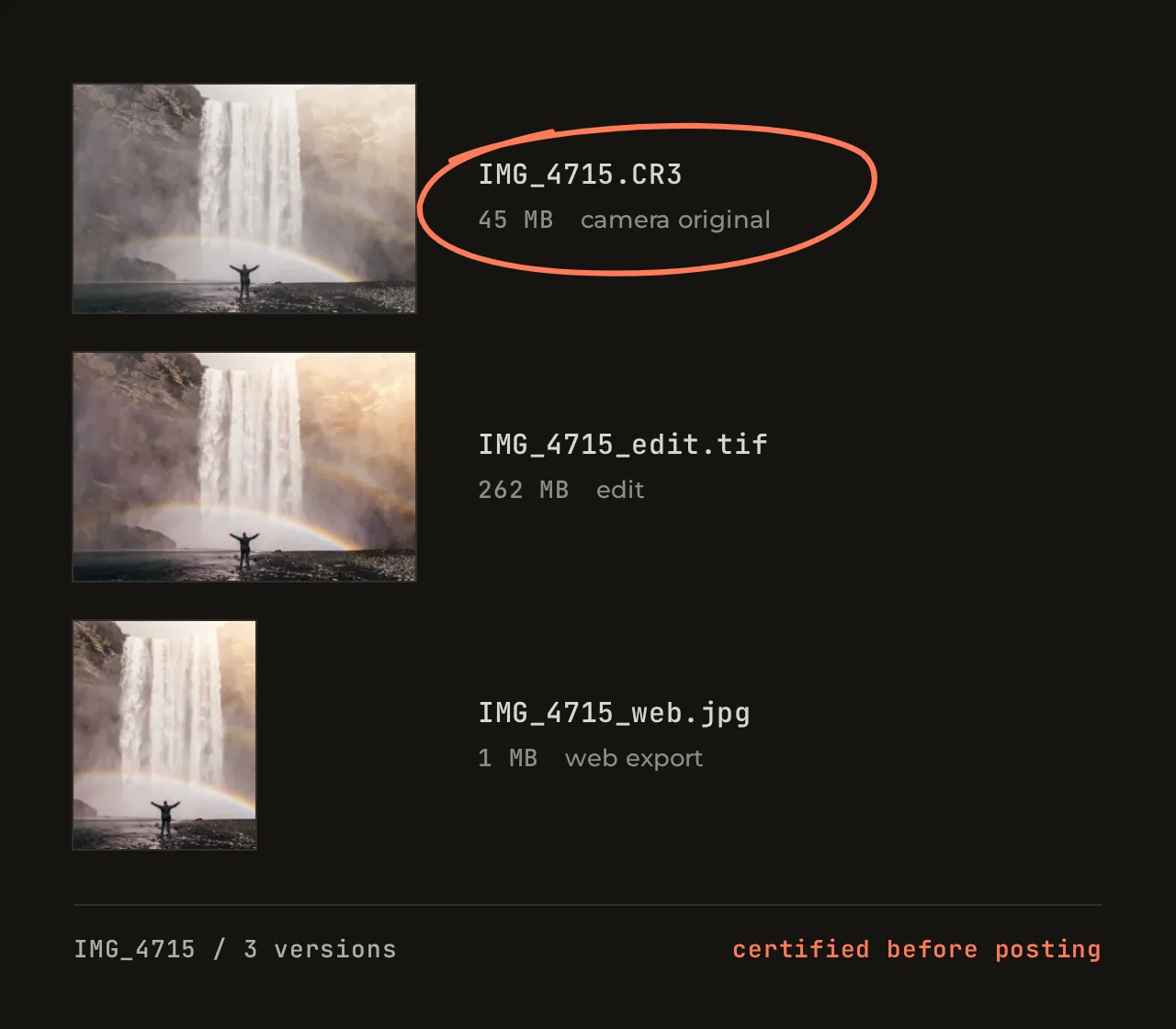
The fingerprint changes if a single byte of the file changes. Re-export a JPEG at a different quality setting, crop it, or let a platform recompress it, and you have a new file that no longer matches the certificate. So certify the files you would actually put on the table later:
- The camera original. The RAW file, or the original JPEG straight from the card. It is your strongest file because nobody else has it.
- The version you publish or deliver. When a copy turns up online, it was usually taken from this one, so this is the file a platform or client can compare against.
Certifying both costs two certificates. For a whole shoot, one folder certificate covers every file in it, and our guide to certifying many photos at once shows how that works.
Your photo does not have to leave your computer. StampR calculates the fingerprint in your browser and sends only the fingerprint, unless you choose to store the original with the certificate.
Four moments when it is worth getting one
- Before you post. Instagram, Behance, your portfolio site. Once an image is public, anyone can download it, and the earliest dated record is the one that counts.
- Before you send files to a client. Previews without a watermark and final deliveries are the files most often reused without payment. A certificate dated before the email went out settles the "who had it first" question.
- Before a competition or a stock agency. Entries and submissions pass through other people's hands and servers. Certify what you submit, in the exact version you submit.
- Before you sell the first print of an edition. Then the certificate number can go on every COA in the edition.
A five-minute routine before you post or send
- Pick the camera original and the export you are about to publish or send.
- Open stampr.eu/stamp, add the file and give it a title you will still recognise in a year.
- Check the name in the holder field. It is printed as entered and cannot be changed after the certificate is issued.
- Download the PDF and the timestamp file (.tsr).
- Keep both next to the original photo, in the same folder and the same backup.
What it shows and what it does not
The certificate shows that this exact file existed at that moment, that it has not changed since, and that you declared yourself its author at that moment. The date comes from a qualified trust service provider, not from StampR's clock or yours.
It does not create copyright, because you have that already. It does not register anything with a government. It cannot decide authorship on its own either: if someone else certified a copy of your photo before you did, their date is earlier, which is why certifying before you publish matters. And for a U.S. work it does not replace registering with the Copyright Office before a U.S. lawsuit.
If someone does copy your photo, the certificate is one piece of your evidence, next to the RAW file, your editing history and your delivery emails. Our guide to building an evidence trail for your photos covers the rest, and what to do when someone uses your photo covers the first 24 hours.
How a client or platform checks it
Send the PDF. The other side scans the QR code or enters the certificate number at stampr.eu/verify. If they also have the file you sent, they can drop it into the file check: the fingerprint is calculated on their device and compared with the one on record.
If you keep the certificate private, the check shows only the evidence: the certificate number, the fingerprint, and the date and time. Your name, the title and the PDF stay with you.
What it costs
A certificate costs €6.80. The first certificate on a free account costs €4.90. You pay per certificate, and prepaid packs on the pricing page are optional. Get a certificate for your photo.
Common questions
Is a certificate of authorship the same as copyright?
No. Copyright in a photo arises when you take it, without any paperwork in most countries. The certificate is a dated record you can show when someone questions whether the image was yours first.
Can I certify a photo I took years ago?
Yes, but the certificate carries today's date: it records when you certified the file, not when you took it. Your RAW files, catalogue history and old delivery emails are what support the earlier date.
Do I need a separate certificate for every photo?
No. A folder certificate covers every file in a shoot or project with one certificate, and each file keeps its own fingerprint.
Does it count outside the EU?
The eIDAS presumption about the date and integrity applies in the EU. Elsewhere the certificate is a document like any other piece of evidence, and the court decides how much weight to give it.
Can I keep my photo and my details private?
Yes. The photo stays on your device unless you choose to store it, and a private certificate shows only the evidence on the public check page.
Sources
- U.S. Copyright Office, What Photographers Should Know about Copyright.
- 17 U.S.C. §§ 411(a) and 412: registration before suit for U.S. works, and statutory damages.
- U.S. Copyright Office, Group Registration for Published Photographs.
- Berne Convention, Article 5(2): no formality required for copyright.
- eIDAS Regulation (EU) No 910/2014, Article 41: legal effect of qualified electronic timestamps.
- Artlogic, Certificates of authenticity – what galleries and artists need to get right.
Certify your work with a trusted date.
Create a certificate →Your first certificate is €4.90 with an account.