How to Copyright Multiple Photos at Once: One Certificate for the Whole Shoot
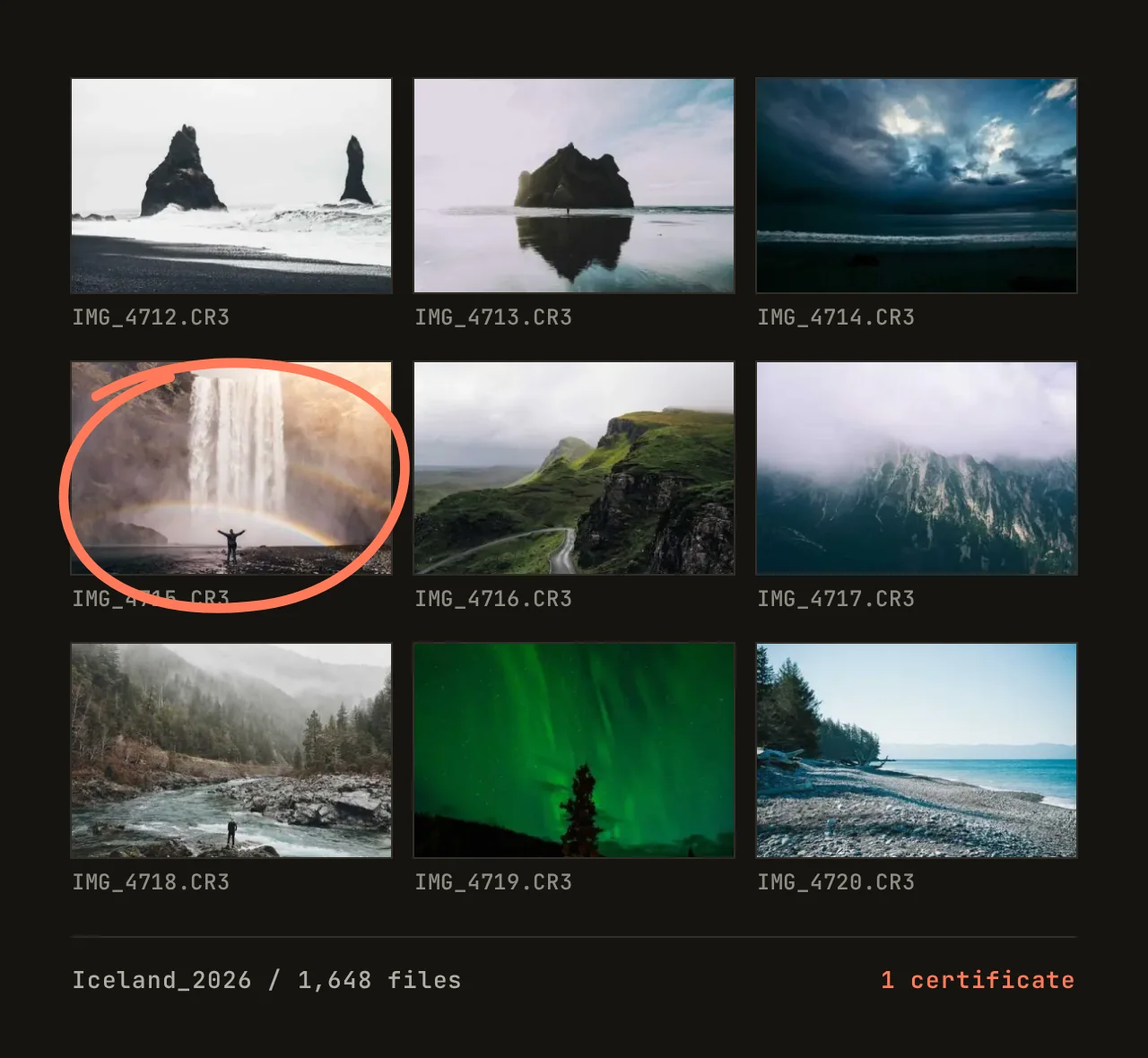
You don't have to copyright photos one by one. Copyright in a photo exists the moment you press the shutter, for every frame of the shoot, in every country that has signed the Berne Convention. What a whole shoot needs is evidence you can show later: a record that these exact files existed on a given date and that you declared them yours. In the US, the Copyright Office lets you register up to 750 photos in one application. Across most of Europe there is no register for photos at all, and where a voluntary one exists, it does not create the right. Since 20 November 2026, StampR issues one certificate for an entire folder: up to 3,000 files for €29, or up to 10,000 for €59, sealed with a qualified electronic timestamp from BORICA B-Trust. Your photos never leave your computer.
This is general information, not legal advice for a specific dispute.
What "copyrighting" a batch of photos actually means
When photographers search for this, they usually mean one of three things:
- Owning the photos. That part is already done. Under Article 5(2) of the Berne Convention, copyright arises without any formality, so there is no form to fill in.
- Being able to sue in the US. For US works, registration with the U.S. Copyright Office is required before you can file an infringement suit in federal court, and registering in time unlocks statutory damages.
- Being able to show the photos are yours. A client says you delivered fewer files than agreed. A hotel uses a frame from your wedding gallery in its advertising. A stranger enters your photo in a competition. Each time, you need a dated record of the exact files.
Most photographers in Europe need the third one, and they need it for hundreds or thousands of files at a time.
Your options for a whole shoot, compared
| Option | What it gives you | Limit |
|---|---|---|
| U.S. Copyright Office group registration | A public record for up to 750 photos per application, for one filing fee | Same photographer and claimant for every photo; published photos must come from one calendar year and can't be mixed with unpublished ones; matters mainly if a dispute would be heard in the US |
| Voluntary national deposits, such as Spain's Registro de la Propiedad Intelectual, France's e-Soleau or Italy's SIAE deposit for unpublished works | An official date for what you deposit | Country by country, and none of them creates the right |
| Emailing the shoot to yourself or uploading it to the cloud | A date you can point to | You control the account, so the date is easy to dispute |
| RAW files and EXIF metadata | Show you were behind the camera: the camera serial number, the unedited frames around the one in question | EXIF can be edited, so it shows the process without fixing a trusted date |
| A single certificate per photo | A qualified timestamp and a verification page for each image | €6.80 per photo, from €3.98 with a pack: right for your ten best frames, impractical for 1,400 |
| One folder certificate | One qualified timestamp over the fingerprints of every file in the shoot, with each file still checkable on its own | Records your declaration and the time; it does not establish who took the photos, so keep the RAW files too |
If you are comfortable in a terminal, you can also build the file list yourself and certify it with a single certificate, as described in how to timestamp hundreds of files with one certificate. Most photographers would rather drop a folder into the browser, and that is what folder certificates are for.
Why we built folder certificates
Wedding and event photographers asked for them. When we met a professional photographers' association in November 2026, members described single events of 1,200 to 20,000 frames. Paying per photo was never going to work at that scale. Even the US scheme would need 27 applications for a 20,000-frame event. What they asked for was one certificate per event, one price per event, and a way to show a single frame later without handing over the rest of the gallery. That is what a folder certificate does.
A wedding photographer's workflow, from card to delivery
This order works for any event shoot:
- Cull and export first. Put the delivered JPEGs and the RAW files behind them into one folder named after the event. The JPEGs show what the couple received. The RAW files show you were behind the camera.
- Certify the folder before anything leaves your computer. Sign in, open the folder page from the pricing page and drop the folder in. Your browser generates a SHA-256 fingerprint for every file locally, which takes a while for a card full of RAW files. Choose a title a stranger would understand a year from now, such as "Wedding of A. and M., Plovdiv, 14 June 2026".
- Decide what the file list may reveal. If file names carry the couple's names or the venue, record anonymous numbers instead, and keep the mapping file your browser gives you with the originals.
- Name your second shooter. Their frames are their work. Add them as a co-author, or leave their files out.
- Deliver the gallery, then the client link. The couple picks the files they received, and their browser checks each one against the certificate. They see how many are included and nothing about the rest of the folder.
- Archive the folder unchanged. Keep it in two places, together with the PDF certificate, the file list and the verification package. StampR stores fingerprints, never the photos, and any later edit gives a file a new fingerprint, even metadata written into it.
The folder page itself, everything in the verification package and the full price list are covered step by step in one certificate for a whole folder.
When a photo from the shoot turns up somewhere
Say a hotel puts one of your wedding frames on its website. Drop your original on the verification page. Your browser generates its fingerprint, and the page names the certificate that covers it and the time of the qualified timestamp. The matching line in your file list ties that exact file to the list, and the fingerprint of the list is the one sealed on the certificate. You show the hotel, a lawyer or a court-appointed expert that one line and nothing else from the gallery. Add the RAW file of the same frame, and you have both halves: when the file existed, and who was behind the camera.
If the certificate is private, strangers who look it up see only the evidence: the certificate number, the time and the fingerprint. An expert can validate the timestamp offline, as described in our guide for court-appointed experts.
Not only for photographers
Anyone who finishes work as a batch of files has the same problem as an event photographer. A few cases:
- Videographers certifying the rushes and the final cut of one event. A single file can be up to 50 GiB.
- Brand designers handing over a full identity: logo variants, palettes, templates and the guidelines PDF.
- Illustrators recording a whole series, the spreads of a picture book, or a portfolio on the day it goes to an agency.
- Producers sealing an EP's stems, sessions and masters before they go to a mix engineer.
- Developers certifying a release build or a dataset exactly as shipped.
- Authors and researchers recording every draft of a manuscript, or the raw data behind a paper.
- Architects fixing a competition entry, drawings and renderings together, before submission.
For one important file, such as a competition photo or a single logo, a single certificate is the simpler choice.
What it costs
A folder certificate costs €29 for up to 3,000 files and €59 for up to 10,000. If you shoot an event every month or so, the annual plan gives you 12 folder certificates to use within 12 months for €249, prepaid, with no automatic renewal. Prices include VAT. All options are on the pricing page.
Two limits to keep in mind
- It records your declaration and the time. It does not establish who took the photos. Your RAW files, contracts and messages with the client do that.
- It covers exact files. A retouched or re-exported image has a new fingerprint, so certify important re-edits again. The certificate creates no rights, and StampR never sees what the files contain.
The background: what a declaration of authorship is, and how copyright protection arises in the EU. For a single image, see how to show a photo is yours, and if a photo may already be in use somewhere, how to find out if someone stole your photos.
Common questions
Can you copyright multiple photos at once?
You already have: copyright arises automatically for every photo you take. What you can do at once is create evidence for the whole set. In the US, that is a group registration of up to 750 photos. Elsewhere, a folder certificate seals the fingerprints of up to 10,000 files with one qualified timestamp.
How many photos can I register at once with the U.S. Copyright Office?
Up to 750 per application, using its group options for published or unpublished photographs. All photos need the same photographer and the same claimant, and published photos in one group must have been published in the same calendar year.
Who owns the copyright in wedding photos?
In most countries, the photographer, as the person who took them. The couple usually receives a licence to use the photos in the ways the contract describes, such as prints and social media. A written contract can transfer the economic rights, and the details differ from country to country, so check the law where you work.
Is EXIF data enough to show a photo is mine?
Rarely on its own. EXIF records the camera, its serial number, the settings and a capture time, but free tools can edit all of it. It carries more weight next to the RAW files of the same scene and a qualified timestamp that fixes when the exact files existed.
Does the certificate count in other EU countries?
The timestamp in it is a qualified electronic timestamp under the eIDAS Regulation, issued by BORICA B-Trust, a provider on the EU Trusted List. Under Article 41(2), its date and time are presumed accurate and the data it covers is presumed unchanged since then. Article 24a(6) provides for its recognition in every member state.
Sources
- Berne Convention, Article 5(2): no formality required for copyright.
- U.S. Copyright Office, Group Registration for Published Photographs and Circular 42: the 750-photo limit and eligibility rules.
- 17 U.S.C. §§ 411 and 412: registration before suit for US works, and statutory damages.
- eIDAS Regulation, current Articles 41(2) and 24a(6): time, integrity and recognition.
- EU Trusted List: Bulgaria (BORICA B-Trust).
Certify your work with a trusted date.
Create a certificate →Your first certificate is €4.90 with an account.