How to Prove a Photo Is Mine
To prove a photo is yours, you need a traceable trail showing the shot exists in your hands and since when. Gather the original RAW file and the full frame series, keep the edit versions, and secure a trusted date on your authorship declaration. Authorship is proven with a history — not a single claim.
What actually shows a photo is yours
Many photographers think owning the file is enough. But anyone can hold a copy of a file. What sets you apart as the author is access to what only the creator has: the raw RAW, the full burst of frames around the chosen one, the edit layers. Combined with an independent date, that builds proof that's hard to contest.
Steps to build the proof
- Keep the original and the series. The RAW file and neighboring frames from the same session — the thief has only the final JPEG.
- Keep the edit process. Versions, layers, history — they show the shot went through your work.
- Secure a trusted date. An independent date on your authorship declaration, placed as early as possible, ideally before publishing.
How much each piece of proof carries
| Evidence | Gives a trusted date? | Weakness |
|---|---|---|
| EXIF metadata | No | Easily stripped or altered; not independent |
| RAW file / frame series | No | Shows you made it, but not when |
| Online post date | Partly | Contestable; platform isn't an independent witness |
| Authorship-declaration certificate with a trusted date | Yes | Doesn't establish who created the work for you — it certifies when and by whom the declaration was made |
StampR issues a certificate that records when and by whom an authorship declaration was made. It isn't a rights registry and doesn't establish for you that you're the author — but it adds an independent date to your evidence. Together with the RAW file and the frame series, the date turns "this is my photo" into a traceable history.
Secure a trusted date for your photo — your first certificate with an account is €4.90.
If someone is already using your photo without permission, see what to do if your photo is stolen.
For the basics: what a declaration of authorship is, what it proves and what it doesn't.
The wider context: copyright protection — how the right arises, and where it is weak in practice.
The mechanism behind the date: how qualified timestamping records when a file existed — the standards it runs on, and what it does not establish.
Frequently asked questions
Is the RAW file enough to show the photo is mine?
It's a strong element — a thief rarely has the RAW. But it doesn't show when the shot was created. That's why it's combined with a trusted date.
Does EXIF data show who the author is?
Not on its own. EXIF is easily edited and its date isn't independently verified.
When is the best time to secure the date?
As early as possible, ideally before you upload the photo publicly. Any date from before the first post is stronger.
Do I need to date every photo individually?
For important shots, yes. For whole sessions you can date the key images or a session archive, as needed.
Which record answers which question
Each record answers a different question. Grouping them by question is more useful than ranking them by strength.
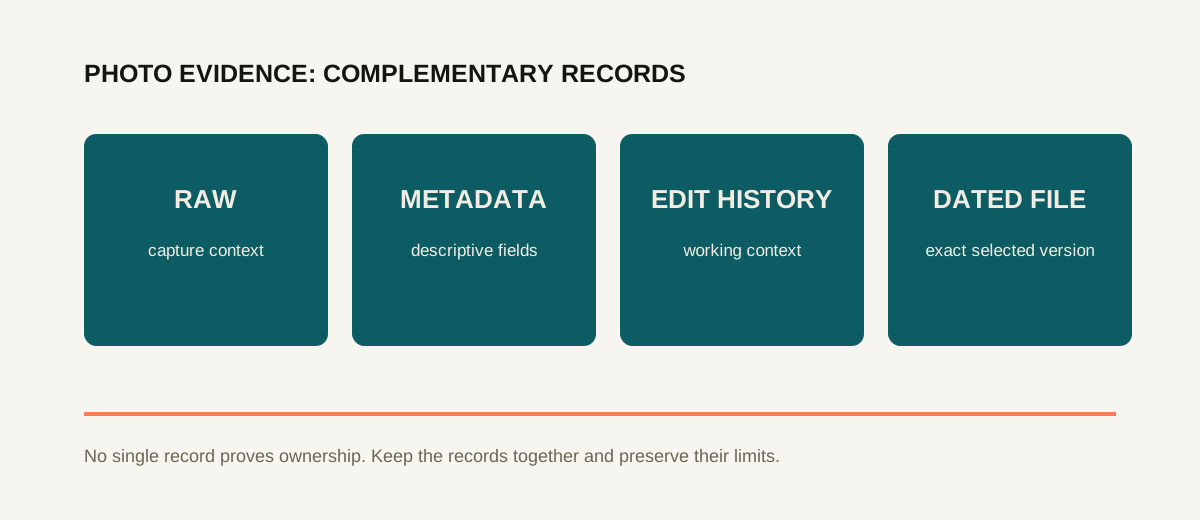
- Who made it: the RAW file, the frames before and after, the edit layers and catalogue history.
- What the camera recorded: EXIF, kept intact by storing one untouched original beside your edits.
- When it became public: the post or publication, with its URL.
- When it existed independently: a dated record of one exact file — which none of the above provides.
- Which file to date: usually the export you are about to share, or the archived original.
EXIF and edit history can be altered or stripped, and a dated record says nothing about who created the work. These records are useful together, not individually.
The full photographer workflow · Primary source: CIPA: the Exif standard
Certify your work with a trusted date.
Create a certificate →Your first certificate is €4.90 with an account.