How to Prove a Design Is Mine in a Client Dispute
If you're already in a dispute with a client over who owns the design, your strength is an organized body of proof — not a louder voice. Gather the correspondence and file versions, build a timeline of creation, and secure a trusted date on your authorship declaration. Disputes are settled by who can show a traceable history — not who claims most confidently.
Collect the proof you probably already have
- The file versions. Drafts, intermediate variants, the final export. The client has only the end result — you have the whole path to it.
- The correspondence. The brief, the feedback, the revisions. It shows the work went through your process.
- A timeline. Arrange everything chronologically. The sequence itself is a strong argument.
How to present a timeline that carries weight
The problem in a dispute is that each piece of evidence can be contested individually — a file date can be changed, an email can be alleged to be staged. What's hard to rebut is an independent date placed at the moment of creation. When it predates anything the client can show, the timeline becomes yours.
How much each piece of proof carries
| Evidence | Gives a trusted date? | Weakness |
|---|---|---|
| File date on your computer | No | Easily changed; not independent |
| Email correspondence | Partly | Shows the process, but dates can be contested |
| Cloud versions (Google Drive etc.) | Partly | Better, but depends on the platform |
| Authorship-declaration certificate with a trusted date | Yes | Doesn't establish who created the work for you — it certifies when and by whom the declaration was made |
StampR issues a certificate that records when and by whom an authorship declaration was made. It doesn't settle the dispute for you or prove you're the author — but it adds an independent, dated anchor to your timeline that the client can't rewrite. In a dispute, that's often the difference between a stalemate and a position.
Secure a dated anchor for your design — your first certificate is free.
If the client used the work without paying at all, see what to do when a client steals your design.
For the basics: what a declaration of authorship is, what it proves and what it doesn't.
The wider context: copyright protection — how the right arises, and where it is weak in practice.
The mechanism behind the date: how qualified timestamping records when a file existed — the standards it runs on, and what it does not establish.
Frequently asked questions
How do I show the work is mine if there was no contract?
With a combination of file versions, correspondence, and dated proof. Without a contract, the timeline is what builds your position.
The client claims they came up with the design. What helps?
Proof the process went through you — the drafts and an earlier trusted date. A finished file alone doesn't show who created it; the path to it does.
Do I need a lawyer?
Not to gather the evidence. If the dispute reaches court, an organized timeline with dated proof is exactly what a lawyer will use.
Is it too late to certify now, mid-dispute?
Certifying now documents your declaration as of today — useful, but weaker than a date from before the dispute. So for future projects, date at creation.
The design evidence stack
Design work leaves a layered trail. Each layer is weak on its own and considerably harder to contest as a set.
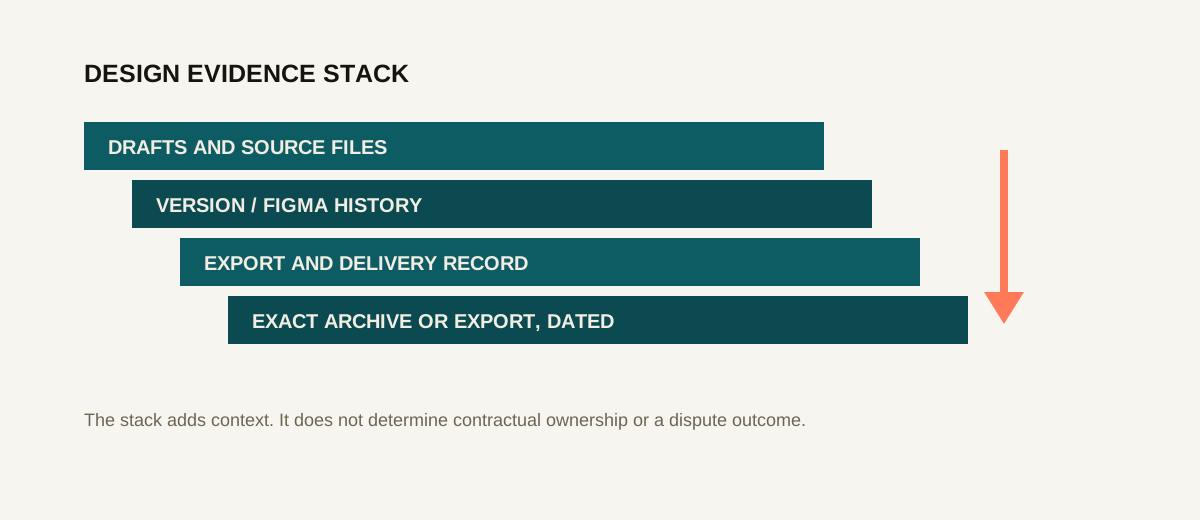
- Sketches and early drafts, including the directions you discarded.
- The editable source file, with its layers and component structure.
- The collaborative history — who changed what and when, in Figma or your version control.
- The exports you actually delivered.
- The delivery record: message, transfer or shared link, with a date.
- A dated record of one exact file from the stack.
Exported files do not carry the version history behind them, account ownership is not the same as authorship, and none of these layers decides who holds the rights under an agreement.
The full designer workflow · Primary source: Figma: ownership and export limits
Certify your work with a trusted date.
Create a certificate →Your first certificate is €4.90 with an account.